
Review · AKROTIRI TOURS
Guided Tour to the Akrotiri Archaeological Site in Santorini
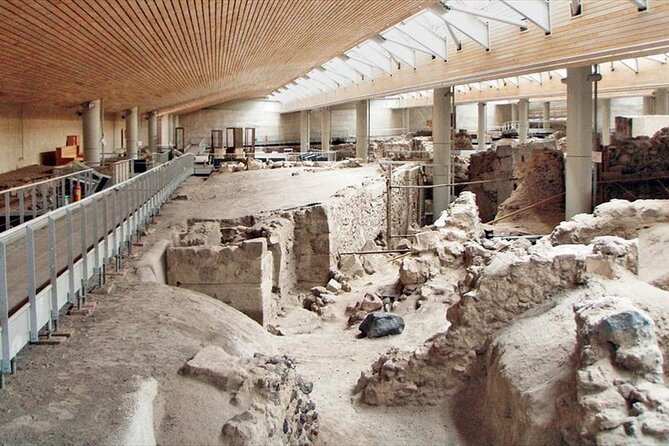
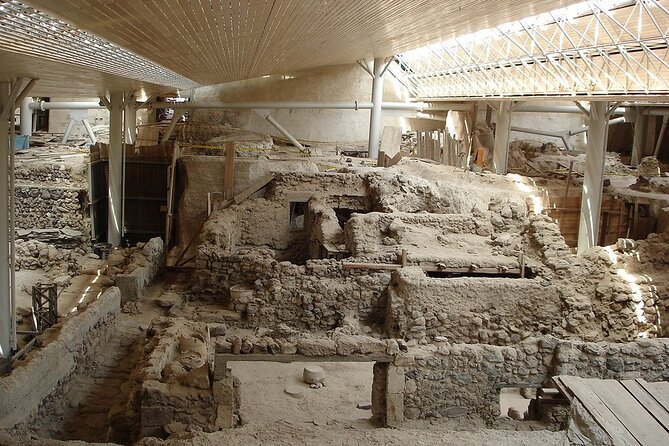
Akrotiri is not just a pile of old stones. It is a buried town, preserved after the volcanic eruption of 1612 BC, with cobbled lanes, tall buildings, workshops, kitchens, storage rooms, and traces of colorful wall paintings. A guide helps you read the ruins as a real neighborhood rather than a silent maze.
I like the small maximum group of 20, which gives the guide a fair chance to explain details without turning the visit into a moving crowd. I also like the compact schedule: you spend about two hours at the site and still have most of the day free for Fira, the coast, or another Santorini plan.
The main drawback is cost. At $181.10 per person, you still pay the 20 euro Akrotiri entrance fee separately. That makes this a better choice for visitors who want guided context than for independent sightseers who are happy to read signs and explore at their own pace.
Key points at a glance
- See a town sealed by volcanic ash: Akrotiri’s streets and buildings show how a prehistoric settlement was organized before the eruption.
- Expect an English-speaking guide: The guide leads the walk and explains the purpose of the rooms, buildings, and murals.
- Study the West House: This compact building included storage rooms, workshops, a kitchen, and a mill installation.
- Look for the Women’s House: Its name comes from a mural showing Ladies and the Papyrus.
- Meet in Fira and return there: The tour begins and ends at KTEL Santorini by the old hospital, also marked Eparxeio.
- Budget for the separate entrance fee: Adults pay 20 euros at the archaeological site, while admission is free for ages 0 to 18.
Why Akrotiri is one of Santorini’s essential history stops
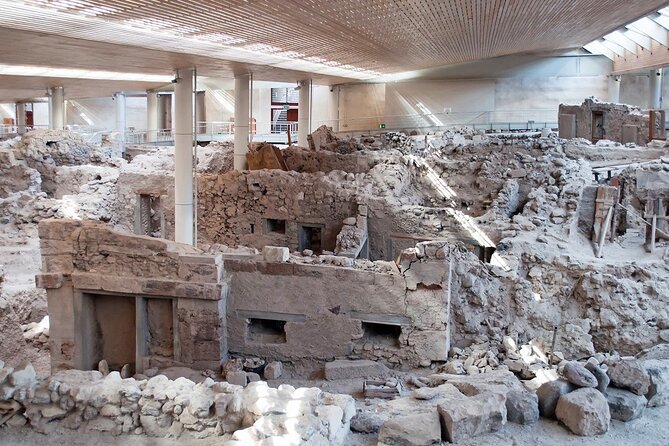
Santorini is famous for caldera views and white villages, but Akrotiri explains why the island looks the way it does today. The site was destroyed by a huge volcanic eruption in 1612 BC, an event that reshaped the island and buried the settlement.
That burial is the key to the visit. Instead of seeing only foundations, you can walk through the remains of a prehistoric town with substantial buildings and defined streets. The ruins give you clues about daily life: where people stored goods, prepared food, worked, moved through the buildings, and decorated their homes.
The site is sometimes described as an Aegean Pompeii. The comparison is useful, though you should not expect a Roman city or a preserved human drama on the same scale. Akrotiri belongs to a much earlier world, and its appeal comes from seeing how advanced and carefully planned that settlement was.
I find the site more rewarding when a guide points out how the pieces fit together. A doorway, a room, or a painted fragment can seem vague on its own. With an explanation, it becomes part of a home, workshop, or working neighborhood.
More Akrotiri tours and tickets:
- Akrotiri: Guided Horseback Riding Day Trip to a Beach
★ 4.9 · 477 reviews - Santorini: Akrotiri Entry Ticket and Audio Guide
★ 3.9 · 348 reviews - Archaeological Bus Tour To Akrotiri Excavations & Red Beach
★ 4.6 · 280 reviews
Meeting in Fira and making the half-day fit
The tour starts and ends at KTEL Santorini, Fira 847 00, near the old hospital, identified locally as Eparxeio. That fixed meeting point is useful if you are staying in or near Fira, but you should plan your route to the meeting place before the start time.
The tour lasts about two and a half hours overall. The archaeological visit itself is listed at about two hours, leaving the rest of your day open. This is a good shape for a Santorini itinerary because you can pair it with another activity without giving up a full morning or afternoon.
The transfer from and to the meeting point is included. The exact transfer details are not specified, so you should not assume hotel pickup. Plan to reach the KTEL meeting point yourself unless your booking instructions tell you otherwise.
A mobile ticket is provided, and the tour is offered in English. The group can include up to 20 people. That is not a private experience, but it is a manageable size for a site where you need to hear explanations and keep moving through defined areas.
Walking through the prehistoric settlement
Once inside, you will walk along the cobbled alleys of Akrotiri and look into buildings that rose at least two stories. The remains show a settlement with planning and structure, not a scattered rural village.
The guide’s job here is to help you notice scale. A large building could contain fourteen rooms on each floor, with several rooms connected by doors. That detail tells you something about how people moved through the building and how different parts of daily life were linked.
Some rooms were decorated with murals. The paintings are not merely decoration for decoration’s sake. They give the ruins color and offer clues about the people who lived there, even though the information available from the provided tour details does not specify every scene or artifact you will see.
You will also get a sense of height. The reference to high-rise buildings may sound surprising when you picture an ancient settlement, but the remains point to multi-story construction. That makes Akrotiri especially interesting for anyone who likes architecture, city planning, or practical details of past life.
The site is a working archaeological area, so this is not a casual stroll through an open-air village. You are there to observe the preserved remains and listen as the guide connects them. Wear comfortable shoes and expect to spend much of the visit on foot, since the experience centers on walking the settlement.
The large building with fourteen rooms per floor
One of the most striking structures is a large building that had at least two floors and fourteen rooms on each floor. Several rooms were connected by many doors and carried murals on their walls.
That layout gives the guide plenty to explain. You can think about how people moved between rooms, how the building may have been divided into working and living areas, and how wall paintings changed the feel of the interior.
The exact original use of every space is not provided, so a good guide should distinguish between what archaeologists can identify and what remains uncertain. That is one reason guided visits work well here. You are not just counting walls. You are learning how to look at evidence without treating every interpretation as a proven fact.
For you, the building is likely to be one of the clearest examples of Akrotiri’s size and organization. It also helps correct the idea that prehistoric communities were simple or poorly built. These structures required planning, labor, and a strong sense of how a town should function.
A few more Santorini trips worth weighing up
- From Heraklion/Crete: Santorini Island Guided Day Trip
★ 4.4 · 1,448 reviews - Santorini: Sunset Guided Tour with Hotel Pickup
★ 4.8 · 900 reviews - Santorini Luxury Custom Private Tour with Local guide
★ 5.0 · 623 reviews - Fira: Guided Foodie Walking Tour with Tastings
★ 4.9 · 474 reviews
The West House and the practical side of daily life
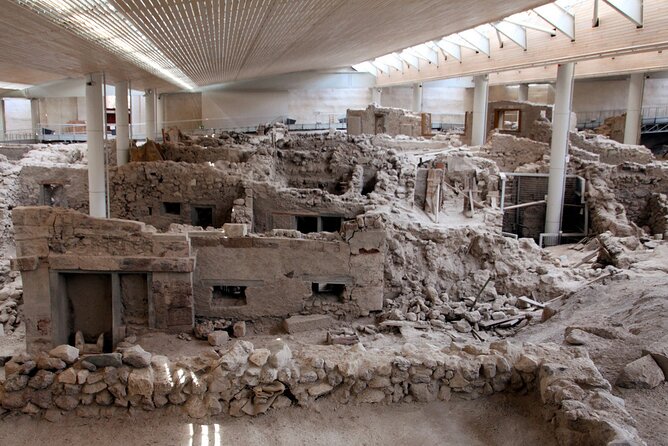
The West House is smaller than the large multi-room building, but its layout is described as well organized. On the ground floor, you will learn about warehouses, workshops, a kitchen, and a mill installation.
This is the kind of stop I value because it turns archaeology toward ordinary work. Warehouses suggest storage and supply. Workshops point to skilled labor. A kitchen connects the site to food preparation, while the mill installation hints at the equipment needed to process food.
You may find this building easier to understand than a grand residential structure because its uses are practical and familiar. Even without reconstructing every detail, you can picture a place where supplies were kept, things were made, and meals were prepared.
The West House also shows why the guide’s role matters. The ruins do not come with modern labels on every wall. An English-speaking specialist can point out the difference between a storage room and a working area, then explain how the building operated as a whole.
The Women’s House and its mural
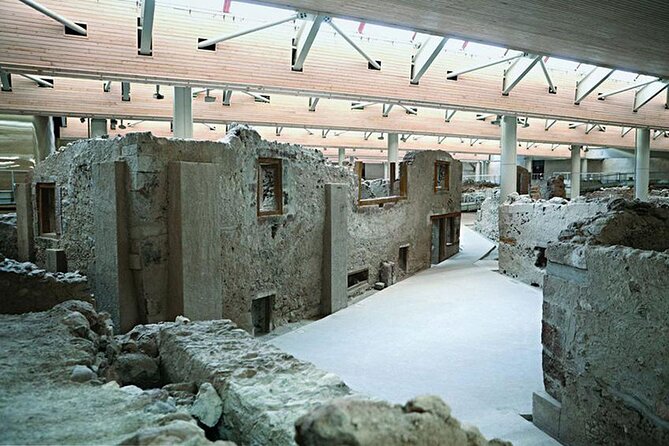
The Women’s House is a large, two-story building named for the mural of the Ladies and the Papyrus that decorated its interior. The name immediately gives the stop a visual hook, and the mural helps you connect a building to the people who once used it.
Do not expect the name to answer every question about the building. The supplied details explain where the name comes from, but they do not establish that the structure was used only by women. Treat it as an archaeological name tied to the painting, not as a complete description of the building’s purpose.
This stop is valuable because it brings art into a visit that could otherwise focus only on masonry and floor plans. The murals remind you that Akrotiri was not only functional. People also cared about the appearance of their homes and the images they placed around themselves.
If you enjoy ancient art, this may be the moment that makes the tour worth the price. If your main interest is volcanic geology or ruins without decoration, the West House and the larger building may hold more appeal.
What the guide adds to the experience
The tour includes a licensed English-speaking guide. No guide name is provided, so you should not book this expecting a particular person. The important point is the format: you have someone leading the route and explaining the settlement as you go.
The strongest feedback available praises the guide for being exceptional, easy to understand, and well informed about the location. That is exactly what you need at Akrotiri. Clear speech matters in a group setting, especially when several people are gathered around a wall painting or narrow passage.
A guide also helps you use your limited time. With only about two hours at the site, you do not want to spend most of the visit wondering which building you are looking at. The tour highlights the large multi-story structure, the West House, and the Women’s House, so you get a focused introduction rather than an unstructured walk.
Still, a group tour cannot tailor every minute to your interests. If you want to study one mural at length, take your time with every architectural feature, or move at your own pace, an independent visit may suit you better. The tradeoff is simple: the group tour gives you interpretation and structure, while going alone gives you more control.
Is $181.10 a fair price?
The listed price is $181.10 per person, and the 20 euro entrance ticket is not included. Children aged 0 to 18 enter free, but the tour price itself may still need to be checked at booking for each participant.
That is a high price for a two-and-a-half-hour experience, particularly if you are already comfortable exploring archaeological sites on your own. You are paying for the guided service, the included transfer from and to the Fira meeting point, and the convenience of a planned visit rather than a self-directed outing.
The value improves if you want context. Akrotiri is the sort of site where a casual look can leave you with a handful of walls and little sense of the town. The guide’s explanations connect the buildings, murals, storage spaces, workshops, and kitchens into a clearer picture.
It also helps that the tour does not consume your whole day. You can visit Akrotiri in a compact block and still plan other Santorini activities. That matters on a short stay, though the price remains the chief concern.
Before booking, add the 20 euro entrance charge to the advertised cost. Then compare the total with the value you place on an English-speaking guide and included transfer. If those two services are important to you, the price may make sense. If not, the separate admission and high per-person rate are real drawbacks.
Who should book this Akrotiri tour?
I would point this tour toward visitors who want a clear introduction to prehistoric Santorini without spending a full day on history. It fits especially well if you are staying near Fira, prefer an English-speaking guide, and like having a fixed route through a large archaeological site.
It is also a good match for anyone who wants to understand buildings rather than simply photograph them. The large structure, West House, and Women’s House each offer a different angle on life at Akrotiri, from multi-room planning to work areas and wall art.
Families can participate, and most people can take part. The tour is not presented as a specialized activity requiring a particular level of fitness, but it does involve walking around the archaeological site. Comfortable footwear is a sensible choice.
I would hesitate if you are watching your budget closely, have already researched Akrotiri, or dislike group schedules. The maximum of 20 is reasonable, but it is still a group visit, not a private guide.
Booking, cancellation, and useful planning notes
You receive confirmation when you book, and the ticket is mobile. The activity is near public transportation, which helps if you are making your own way to the Fira meeting point.
Free cancellation is available if you cancel at least 24 hours before the start time. Changes or cancellations made less than 24 hours before the experience are not accepted for a refund. The cut-off follows local Santorini time.
The activity requires good weather. If poor weather causes cancellation, you are offered another date or a full refund. Since the tour includes walking around an archaeological site, keep that rule in mind when planning around a tight schedule.
The provider is Pigaia Travel. The tour is offered in English, and the group size is capped at 20 people.
Should you book it?
Book this tour if you want Akrotiri explained by a clear English-speaking guide and prefer a short, organized visit with transport from and back to Fira. The guide is the main reason to choose it, and the praise for easy-to-understand explanations supports that choice.
Skip it if the $181.10 price, plus the 20 euro entrance fee, feels too steep for two hours at the site. Independent visitors can save money, but they will need to supply their own context and plan their own visit.
For a first look at Akrotiri on a busy Santorini itinerary, this is a convenient and focused option. Just budget honestly, meet at the Fira location, and remember that the admission ticket is extra.
FAQ
Where does the tour start and end?
The tour starts and ends at KTEL Santorini in Fira, 847 00, near the old hospital, also identified as Eparxeio.
How long does the experience last?
The full experience lasts approximately 2 hours and 30 minutes. The visit to the Akrotiri archaeological site is listed at about 2 hours.
Is the entrance fee included?
No. Admission to the Akrotiri Excavations costs 20 euros per person. Entrance is free for ages 0 to 18.
What language is the tour offered in?
The tour is offered in English and includes a licensed English-speaking guide.
How many people can join the tour?
The activity has a maximum group size of 20 travelers.
Can I cancel for a full refund?
Yes. You can cancel at least 24 hours before the experience start time for a full refund. Cancellations or changes made less than 24 hours before the start time are not accepted, and poor-weather cancellations offer a different date or a full refund.
Just added around Santorini
- Private Fishing Tour – Sunset (transportation included)★ 5.0 · 25 reviews
- Unique 3-Hour Tour of Santorini for Cruise Ship Passengers★ 5.0 · 3 reviews
- Perivolos: Beach Experience at Wet Stories★ 3.7 · 29 reviews
- Romantic Private Day Tour in Santorini★ 5.0 · 5 reviews
- Santorini Rent a Boat – License free private cruise★ 5.0 · 11 reviews
- Private Fishing Tour – Morning (transportation included)★ 5.0 · 8 reviews
- Winery – Oia Sunset Tour★ 4.5 · 4 reviews
- Woodcarving Workshop in Santorini★ 5.0 · 7 reviews
Akrotiri Tours, compared.

Archaeological Bus Tour To Akrotiri Excavations & Red Beach
Read our review →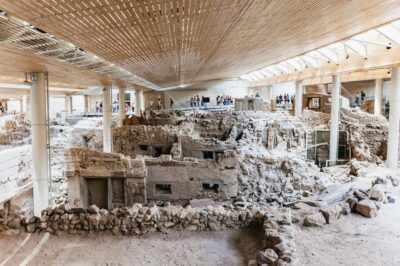
Archaeological Bus Tour to Akrotiri Excavations & Red Beach
Read our review →
Private Cultural Villages Sightseeing & Akrotiri Excavations
Read our review →
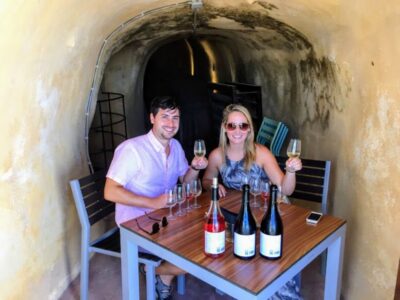
Private Group Visit to Akrotiri & 3 Wineries with Tastings
Read our review →Browse the lists this tour appears in